Focus on What Matters Most: Build Ambition Without Nervous-System Burnout
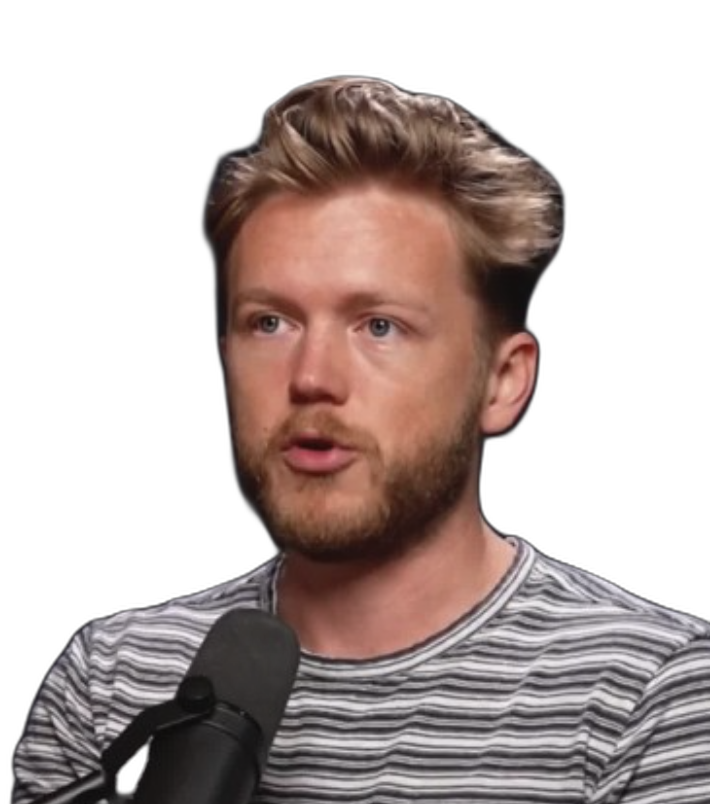
About the guest
Nat Eliason
Nat Eliason is an author, entrepreneur, and online writer. He is the author of Crypto Confidential and Husk, previously founded the content marketing agency Growth Machine, and has written widely on learning, writing, philosophy, entrepreneurship, and personal development.
Learn more →Listen to the episode
The harder focus question: what deserves the next five years?
Nat Eliason had spent years cycling through intense curiosities: apps, courses, a café, an agency, crypto, writing. Each chapter taught him something real. But after the crypto rollercoaster shook loose a lot of assumptions, one question got sharper: what is the thing I can keep compounding instead of repeatedly returning to zero? For Nat, the answer turned out to be writing and building a career as an author.1
That question sits at the nervous-system layer of focus. Distraction isn't always a phone or calendar problem. Sometimes it's a state problem: euphoria, scarcity, shame, urgency, the fear that you're falling behind. When those states take over, a side quest can feel like survival.
This guide is a tactical way to use the conversation: choose the main thing, check what's fuelling you, treat excitement carefully, recover without numbing, and build a rhythm that lets ambition last.
Choose the work you are willing to compound
Nat describes his earlier relationship with work and money as adversarial: how can I win the resource-accumulation game as fast as possible? That frame worked for a while, but it created a habit of jumping into whatever promised the fastest escape hatch.
The cost was cumulative. During the crypto years, Nat's blog and newsletter lost momentum. Readers kept arriving for a while, but the long-term compounding engine had been neglected. Looking back, he saw that abandoning the thing he cared about most for a short-term opportunity was not actually a good trade, even when the short-term opportunity paid well.
The practical move: define your "compounding work" before the next tempting opportunity arrives.
Ask:
- What work would I be proud to still be doing in five years?
- What skill, audience, body of work, or craft gets stronger when I keep showing up?
- What am I repeatedly tempted to abandon when money, novelty, or fear spikes?
- If I had enough runway to keep going, what would I refuse to quit?
Nat eventually reframed his remaining crypto money as runway for becoming an author. In his words, as long as that runway existed, he was "not allowed" to quit the author path and get seduced by another siren song. That kind of pre-committed constraint turns focus from a daily mood into an agreement with your future self.
1For Nervous System Mastery readers, "what matters most" is also a regulation question: when your system feels unsafe, can you still remember the long game?
Check the fuel source before you push harder
A thread worth pulling in this episode is the difference between hard work and the fuel behind hard work.
After burnout-adjacent seasons, it's easy to become afraid of intensity itself. Nat names this directly: after pushing hard and burning out, part of him worried that working hard again would send him back into the same state. I've noticed the same pattern with cohort members, and there's a useful distinction here: sometimes the deeper work is changing the fuel source. Moving from scarcity, proving, and self-whipping toward enthusiasm, meaning, and the work you almost cannot stop doing.
This doesn't mean intrinsic motivation magically prevents exhaustion. People can still overwork on meaningful projects. But research on self-determination theory supports a cautious version of the point: goals tend to function differently depending on whether they're autonomous and need-satisfying, or controlled by pressure, image, and external validation.2
A tactical fuel-source check:
- Name the output. What am I trying to create, ship, earn, or prove right now?
- Name the state. Do I feel clear, alive, and challenged? Or tight, hunted, ashamed, and unable to stop?
- Name the audience. Who am I imagining will approve, rescue, or reject me based on how this goes?
- Name the body cost. What's happening in my breath, jaw, chest, stomach, sleep, and patience as I pursue this?
- Name the cleaner fuel. If this mattered even without applause or urgency, what would be the next honest step?
The aim isn't to remove ambition. It's to stop confusing activation with purpose.
Treat euphoria as a yellow light
One of the most useful parts of Nat's crypto story is how quickly extraordinary numbers became normal. A thousand dollars a day felt insane, then ordinary. A drop to five hundred felt disappointing. Later, much larger fluctuations also normalized. The frightening recognition wasn't that the market was volatile. It was that he had adapted to the volatility without stepping back to ask whether he was okay with who he was becoming.
This is a focus lesson. A big upside can narrow attention as powerfully as fear can. The nervous system starts orienting around the chart, the inbox, the launch numbers, the book sales, the fantasy of what happens if this works.
Nat offers a simple heuristic near the end of the episode: he tends to trust a negative gut feeling more than an intensely positive one. If something feels off, there's useful animal information there. If something feels perfect, euphoric, and obviously life-changing, it usually helps to sleep on it.
Use that as a rule for priority protection:
- If a new opportunity feels quietly meaningful, give it space.
- If it feels urgent, euphoric, and identity-making, slow down.
- If you want to check the scoreboard every hour, that's a signal that something in the underlying work or safety story needs attention.
- If the opportunity would cost two years of progress on your main thing, calculate that cost explicitly.
A good question from Nat's post-crypto stance: If this went incredibly well, would I still wish I had spent the time on my main work instead?
Build recovery that isn't numbing
Nat's line that he'd learned how to numb but hadn't learned how to relax is one of the most relevant Nervous System Mastery moments in this conversation.
When the system is amped all day, it wants a strong brake at night. Alcohol, weed, television, scrolling, food: these are attempts to force a relaxed state from the outside. Sometimes they work fine. The trouble starts when shutdown becomes the only available off-switch, because the state may stop without actually restoring anything underneath.
Nat noticed that active, non-numbing rest often worked better: playing with his kids, walking, reading, breathwork, meditation in appropriate doses, stepping away from the desk when writing got stuck. He also noticed the awkward pendulum: too much pushing led to burnout, but too much withdrawal made him feel like he'd lost his edge.
Work-recovery research (Sonnentag and Fritz) points in a similar direction. Their framework highlights psychological detachment from work, relaxation, mastery experiences, and control during leisure time as distinct recovery experiences associated with recuperation.3 Recovery isn't only "stop working." It may also require a different relationship to attention, choice, challenge, and the body.
Try distinguishing:
- Numbing: "I need this to make the feeling stop."
- Rest: "This helps my system metabolize the day."
- Play: "This brings me back into contact with aliveness."
- Mastery: "This is effortful, but a different channel from work."
- Detachment: "For a while, the main thing is allowed to leave the foreground."
If you can't rest without guilt, don't start by forcing perfect relaxation. Start by making recovery part of the production system. The muscle rebuilds outside the lift. Creative capacity needs cycles too.
Practice
Run the "what matters most" reset
Use this when you feel pulled between a meaningful long-term path and a shiny, urgent, or financially tempting side quest.
- Name the main game. Write one sentence: "The thing I am trying to compound over the next 12 months is…"
- Name the temptation. Write the opportunity, metric, fear, or fantasy that keeps pulling attention away from that game.
- Price the time cost. If you followed the temptation for six months, one year, or two years, what would stop compounding?
- Check the fuel source. Ask: "Is this move coming from curiosity and commitment, or from scarcity, proving, guilt, euphoria, or fear?"
- Create a scoreboard boundary. Decide when you are allowed to check money, analytics, sales, rankings, or other outcome metrics. For some people, a weekly or quarterly check is far healthier than constant monitoring.
- Write one anti-siren rule. Example: "As long as I have runway for this project, I am not allowed to abandon it for a faster-money opportunity without waiting 30 days and talking it through with two grounded people."
- Schedule real recovery. Choose one non-numbing recovery block this week: a walk, play, mobility, reading, breathwork, time with family, or unstructured offline rest.
The aim is practical: make your priorities easier to remember when your nervous system is activated. That's when you need them most, and when they're hardest to access.
Work in seasons
Nat and I both come back to seasonality in this conversation. He describes intense creative sprints followed by weeks where very little seems to happen. The danger is self-flagellation: believing the down cycle is a defect you need to optimize away.
Books naturally create seasons: draft, hand off, wait, receive feedback, revise. I have a similar pattern with cohort-based teaching: launch, teach, recover, create, repeat. The rhythm is never perfectly clean, but the principle matters. If a project demands intensity, recovery should be designed into the architecture rather than treated as a personal weakness.
Nat's drafting experiment makes this concrete. He wrote a large first draft in a compressed period to get another rep, learn faster, and avoid letting a project become too precious. His writing advice is direct: get the first draft done as early as possible so there's time to let it sit, revise, or even start over.
That applies well beyond books:
- Ship the rough version earlier so reality can teach you.
- Let recovery and feedback do some of the work.
- Don't confuse attachment to the current draft with devotion to the craft.
- Build a cadence that makes repetition possible.
Focusing on what matters most is a rhythm of returning: to the craft, the family, the body, the long game. Nat leaves listeners with a question that stuck with me: what are you saving for later that you might run out of time to do?
Key takeaways
- The productive focus question is "Which game am I willing to keep compounding?" Ask it before asking how to do more.
- Shiny opportunities are expensive when they interrupt the long-term body of work, relationships, or skills that matter most.
- Hard work isn't the enemy. The fuel source matters: scarcity and proving create a different internal cost than meaning, curiosity, and commitment.
- Euphoria can distort priorities. Treat intensely positive gut feelings as a reason to slow down, sleep, and calculate the time cost.
- Recovery and numbing are different animals. Active, chosen, non-work restoration often supports better long-term output than forced shutdown.
- Sustainable ambition needs seasons: sprint, recover, revise, repeat.
- Your nervous system will forget the long game under stress unless you build rules, rhythms, and relationships that help you remember.
Free assessment
Take the free nervous system assessment.
If urgency, money anxiety, or overwork keeps pulling you away from what matters most, the assessment can help you map your current stress patterns and choose a steadier next step.
Take the Free AssessmentContinue exploring
- Read Digital Distraction: Reclaim Attention Without Quitting Technology for a practical guide to attention, technology, and agency.
- Read The Best Decision-Making Is Emotional for more on emotion, interoception, and choosing from the body.
- Read How to Increase Your Nervous System Capacity for a broader look at stress dosing, recovery, and resilience.
- Read OCD and Self-Exploration: Stay Curious Without Feeding Rumination for a complementary guide on when inquiry helps and when it becomes a loop.
References
- Nat Eliason, Focusing on What Matters Most, 04:15–12:30. Guest-bio details were cross-checked against Nat's official site, https://www.nateliason.com/, and Penguin Random House's author page for Crypto Confidential, https://www.penguinrandomhouse.com/books/730882/crypto-confidential-by-nathaniel-eliason/. ↩
- For research context, Deci and Ryan's self-determination theory argues that the "what" and "why" of goals matter for motivation and well-being, especially autonomy, competence, and relatedness: "The 'What' and 'Why' of Goal Pursuits," Psychological Inquiry (2000), https://doi.org/10.1207/S15327965PLI1104_01. Kasser and Ryan also found that relatively stronger emphasis on extrinsic aspirations such as financial success, appearance, and social recognition was associated with lower well-being in their samples, while intrinsic aspirations showed more favourable associations: "Further Examining the American Dream," Personality and Social Psychology Bulletin (1996), https://doi.org/10.1177/0146167296223006. These findings support discernment around fuel source; they do not mean money goals are inherently unhealthy. ↩
- Sonnentag and Fritz developed a recovery-experience framework distinguishing psychological detachment, relaxation, mastery, and control during leisure time. See "The Recovery Experience Questionnaire: Development and validation of a measure for assessing recuperation and unwinding from work," Journal of Occupational Health Psychology (2007), https://doi.org/10.1037/1076-8998.12.3.204. This supports the general distinction between recovery experiences; it does not prescribe one universal recovery routine. ↩