Breath-Hold Training, CO2 Tolerance, and Embodied Resilience with Erwan Le Corre
About the guest
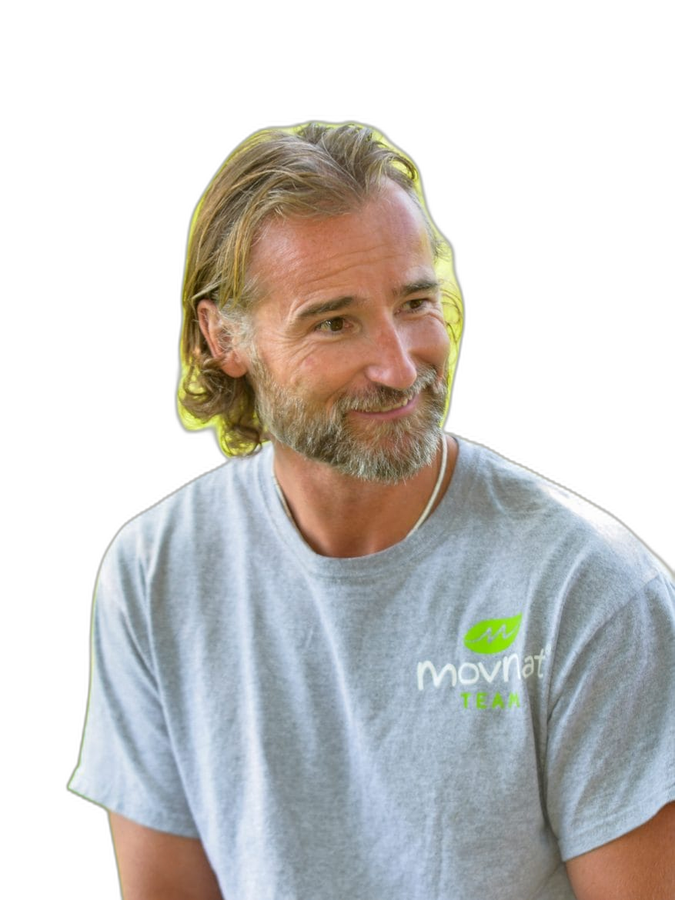
Erwan Le Corre
Erwan Le Corre is the founder of MovNat and a pioneer of natural movement training. His work integrates real-world physical competency, movement in nature, physical education history, and breath-hold practice as a path toward resilience and what he calls our 'True Nature'.
Learn more →Listen to the episode
Breath-hold training gets interesting when it stops being a macho stunt
This conversation with Erwan Le Corre lands at the intersection of breath-hold training, CO2 tolerance, embodied resilience, and natural movement. The most useful takeaway is not that you should try to hold your breath for eight minutes. It is that breath holds can expose how quickly the nervous system becomes physically, emotionally, and mentally agitated under pressure — and how trainable that response may be when the practice is approached with patience instead of bravado.
Use this guide if you are:
- curious about breath-hold training without wanting freediving bro-science;
- interested in CO2 tolerance as a resilience skill, not a party trick;
- trying to move more like a human and less like a desk-bound brain in a chair;
- looking for practical "human zoo counter-measures" you can use in ordinary life;
- wanting a safer, saner entry point into breathwork than max-effort apnea.
1This page covers the 2022-11-01 Curious Humans conversation with Erwan Le Corre. Nervous System Mastery also has a separate published guide carrying episode number 43 with Grimhood, so use the slug and title — not the episode number alone — to tell them apart.
2Educational only. Do not practice breath holds in water alone, while driving, or as a casual challenge. Avoid hyperventilating before any in-water breath hold. If you have cardiovascular or respiratory disease, fainting history, seizure history, panic symptoms that intensify with breathwork, or you are pregnant, get qualified medical or professional guidance first.2
The deeper problem is movement poverty, not lack of workouts
Erwan's phrase for modern life is "movement poverty predicament." His point is blunt: many people do a little exercise, but still spend the overwhelming majority of waking life sitting, standing, and walking a few predictable steps on flat surfaces.
He is talking about frequency, variety, intensity, and variability of movement as inputs for the whole organism, including the nervous system, not only about calories or aesthetics.
| Modern default | Natural-movement correction |
|---|---|
| long blocks of sitting | interrupt the day with brief movement breaks |
| one narrow exercise mode | add more movement variety: squat, carry, climb, hang, crawl, balance |
| only flat, predictable terrain | spend some time on grass, trails, stairs, slopes, floor, or uneven ground |
| relaxation = collapse on couch | relaxation can also mean changing position, breathing, and moving gently |
| training body parts in isolation | remember the body works as a coordinated system |
A strong Nervous System Mastery translation here is simple: a single workout does not fully offset an immobilized day. Three gym sessions per week may still leave you movement-poor if the other 99% of the week is spent in a chair.
Human zoo counter-measures should be frequent, ordinary, and repeatable
One reason this episode works well for Nervous System Mastery is that Erwan does not frame natural movement as an all-day wilderness fantasy. He explicitly says he has a desk job, works at a computer, and has three kids. His recommendation is to look for opportunities that already exist and to be radically honest about how much time is currently leaking into low-value screen use.
The practical version is not glamorous:
- squat or kneel instead of always sitting when you are on your phone;
- spend short breaks outside instead of only scrolling indoors;
- use rings, a bar, or a sturdy support to practice hanging if that is accessible to you;
- sit on the floor sometimes;
- carry things with intention instead of outsourcing every load to convenience;
- build in tiny movement breaks rather than waiting for the perfect one-hour session.
Jonny adds a helpful real-world example: trampoline breaks, ring hangs, sunlight, stretching, and brief outdoor movement between work bouts. That is a much more realistic nervous-system strategy than fantasizing about becoming a different person next Monday.
A useful way to think about "rewilding" in normal life:
| If your day currently looks like... | Try this counter-measure |
|---|---|
| back-to-back desk work | 3 to 5 minutes outside every 30 to 60 minutes |
| doomscrolling at night | deep squat, kneeling, or floor sitting while you scroll less |
| only one exercise pattern | add one new pattern this week: hang, balance, crawl, or carry |
| constant indoor climate and surfaces | get some sunlight, weather, and textured terrain when practical |
| stress in the head all day | use movement as a state shift before you try to think better |
Erwan's breath-hold story is a good warning against doing too much, too soon
One of the best parts of the episode is that Erwan does not present himself as someone who found the perfect method immediately. He says that earlier in his life he trained breath holds "all the wrong way": doing maximum attempts every day, intuitively hyperventilating first, and trying to grind his way longer through sheer will.
That honesty matters because many people still approach breath holds exactly like that:
| Common mistake | Better starting question |
|---|---|
| maxing out every session | can I finish calmer than I started? |
| treating hyperventilation as a shortcut | can I breathe more normally and keep the practice conservative? |
| chasing a time number | can I notice my first urge to breathe without panicking? |
| trying to overpower discomfort | can I reduce unnecessary tension in jaw, face, shoulders, and belly? |
| copying freedivers in water | should I stay with dry-land practice unless I have proper training and safety? |
That does not mean breath-hold practice is useless. It means the useful part may begin when the egoic performance layer drops away.
CO2 tolerance is partly about how you relate to the alarm
Erwan eventually reframes long breath holds as mostly neurological, not merely mechanical. His claim is that the limiting factor is often the mind: agitation, impatience, drift away from intention, and the inability to stay with changing sensations without escalating them.
That is where CO2 tolerance becomes more interesting than a stopwatch. In plain language, the practice can reveal:
- how fast your body mobilizes under internal pressure;
- whether discomfort immediately turns into panic or grasping;
- how much unnecessary muscular bracing you add;
- whether you can sustain a chosen intention once the body stops feeling comfortable;
- how quickly you abandon calm when the urge to breathe becomes loud.
His language here sounds almost meditative. He describes breath holding as a state of neurophysiological stress where your intention has to be sustained in real time, not merely declared once at the beginning.
That makes this less about proving toughness and more about embodied resilience: the ability to notice alarm without instantly obeying it.
Breath-hold work is not the same thing as forcing
Jonny asks a sharp question in the middle of the conversation: what is the difference between a firm intention and simply forcing yourself? Erwan's answer is that both are intentions — but they lead the system in different directions. You can choose the intention to fight, or you can choose the intention to relax and sustain it under pressure.
This is one of the clearest takeaways in the whole episode:
- Set an intention before the hold.
- Expect that intention to be challenged quickly.
- Notice the moment agitation begins.
- Re-choose softness, stillness, or patience instead of assuming autopilot will handle it.
- End the practice before it becomes a battle for identity.
That is a useful frame even if you never become a serious freediver. It maps cleanly onto hard conversations, cold exposure, stress dosing, public speaking, or any moment when the system starts shouting louder than your deeper aim.
A calmer breathing rate may be downstream of calmer conditioning
Later in the episode, Erwan argues that breath-hold meditation can help lower respiratory rate and improve CO2 tolerance faster than breathing exercises alone, while also acknowledging that sleep, health, relationships, and broader lifestyle all affect breathing patterns.
The conservative takeaway is not that breath holds are a miracle hack. It is that repeated exposure to manageable breathlessness may teach the system that it does not need to overreact so quickly.
The broader breathing literature is stronger for slow breathing than for max-effort apnea protocols, so this is one place to stay grounded. If slow nasal breathing and longer exhales already make you more resourced, do not assume a harder practice is automatically better.1
Practice
Try a dry CO2-awareness practice, not a max breath hold
This is a conservative land-based practice for noticing agitation and softening it. It is not freediving training, not a record attempt, and not something to do in water.
- Set up safely. Sit or lie down on land. No pools, baths, driving, workouts, or distractions.
- Breathe normally for 60 to 90 seconds. Easy nasal breathing if available. Let your jaw, throat, and shoulders soften.
- Do one light pause. After a normal exhale, pause only until the first clear urge to breathe. Do not push to a maximal hold.
- Resume gently. Return to quiet breathing without gasping. See if you can keep the exhale relaxed rather than "earning" recovery.
- Repeat for 3 rounds max. Stop early if you feel dizzy, panicky, headachy, or compulsive about going longer.
- Track quality, not time. Ask: "Could I stay softer when the alarm rose?" That matters more than the number of seconds.
If even a light pause feels activating, skip the hold and just extend the exhale slightly. If you want to train in water, get proper freediving instruction and dedicated safety rather than improvising from a podcast guide.2
What to keep from this episode if you never chase a record
You do not need to become obsessed with apnea to get value here. The most portable lessons are simpler:
- Move more often, not only more intensely.
- Add variety before adding complexity.
- Use your environment to help your body remember more positions and patterns.
- Treat breathwork as awareness training, not only performance training.
- Respect the difference between stress that teaches and stress that overwhelms.
If you practice breath holds at all, the win is not "I suffered longer." The win is closer to: "I noticed the system surge, and I did not immediately make things worse."
Key takeaways
- Erwan's "movement poverty predicament" points to a real mismatch between modern life and the amount of varied movement the human organism seems to expect.
- Human zoo counter-measures work best when they are small, frequent, and woven into ordinary routines.
- Breath-hold training is most useful when it builds awareness, relaxation, and sustained intention rather than brute-force heroics.
- CO2 tolerance is not only about chemistry; in this episode it is also a lens on alarm, agitation, and self-regulation under pressure.
- Do not copy hyperventilated, maximal, unsupervised breath-hold behavior. Stay conservative, especially in or around water.
Free assessment
Take the free nervous system assessment.
If your stress response tends to turn discomfort into over-effort, shutdown, or compulsive self-optimization, the assessment can help you map your current pattern and choose a steadier next step.
Take the Free AssessmentContinue exploring
- Read The Science of the Nervous System, Functional Breathwork & Interoception for a gentler framework for using the breath to regulate state.
- Read Leverage Your Physiology for a deeper look at posture, movement, breath, and environment as nervous-system inputs.
- Read How to Increase Your Nervous System Capacity for more on stress dosing, recovery, and resilience.
- Read Reset Your Nervous System for a short, low-friction reset when you need downregulation more than intensity.
References
- A systematic review suggests slow breathing may support autonomic and cardiorespiratory regulation, though protocols and mechanisms vary: Zaccaro et al., “How Breath-Control Can Change Your Life: A Systematic Review on Psycho-Physiological Correlates of Slow Breathing,” Frontiers in Human Neuroscience (2018), https://pmc.ncbi.nlm.nih.gov/articles/PMC6137615/. ↩
- Divers Alert Network safety guidance warns against hyperventilation before breath-hold diving and against diving alone, noting increased risk of hypoxia and shallow-water blackout in unsupervised or poorly trained practice: https://dan.org/alert-diver/article/freediving-safety-awareness/ and https://dan.org/alert-diver/article/hypoxia-in-breath-hold-diving/. ↩