Anxiety: more belly & chest
Belly tension was named by 23.2% in the anxiety track, compared with 17.1% overall. Chest tension: 21.4%, versus 17.0%.
NS1 field notes · 1,632 people · September 2026
Of the people in the depletion track, 58% chose aliveness as the thing they most wanted back.
There’s something worth listening to in that answer. Alongside the fatigue and overwhelm, there’s a wish to have enough left to actually enjoy being here.
So, what else did people tell us?
Start with the body ↓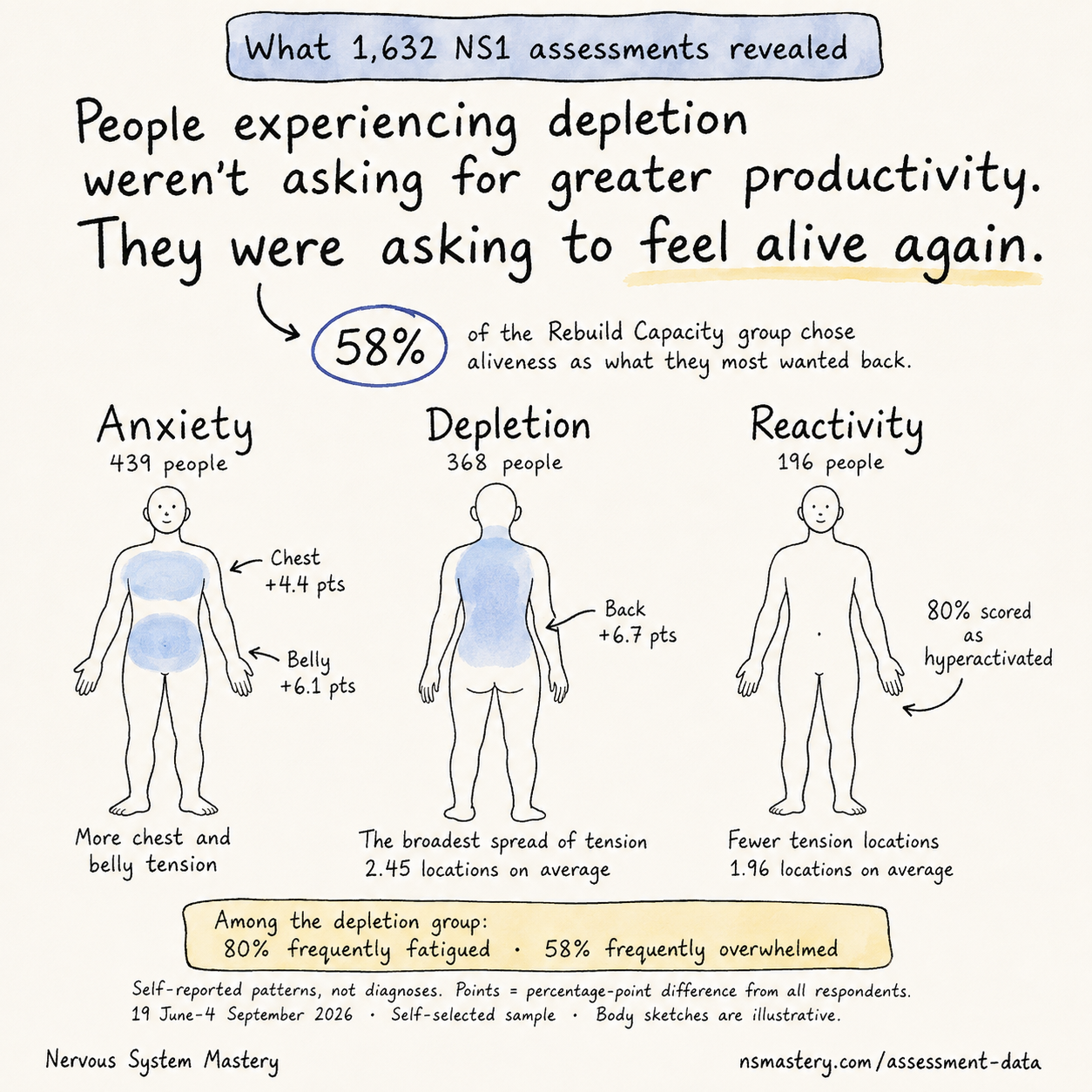
A snapshot of people who chose to take NS1, not a census of everyone’s nervous system. These are self-reported experiences. How we counted
01 / Where we hold it
Almost two-thirds named their neck or shoulders. The jaw came next. But the picture changes a little when you look at what brought people here.
Pick a place on the list →
Darker blue = more people named this area.
Schematic locations, not a scan of the body.
Everyone · n = 1,632
Neck & shoulders: 1045 of 1632 people (64.0%).
2.21 named locations per respondent on average. Multiple choices allowed.
Belly tension was named by 23.2% in the anxiety track, compared with 17.1% overall. Chest tension: 21.4%, versus 17.0%.
This group named the most locations on average: 2.45. Back tension was also more common: 25.8%, compared with 19.1% overall.
The highest share of “hyperactivated” assessment results (80.1%), yet the fewest named tension locations (1.96). More activation didn’t mean more places named.
These are descriptive differences, not diagnostic body maps. We haven’t tested whether the group differences are statistically significant.
02 / The daily load
For many respondents, these experiences overlapped. Almost one in four reported all three.
These describe frequency and morning recovery. They do not establish a medical cause for fatigue or overwhelm.
03 / What brought people here
The other half is what people want to be able to do, feel, or enjoy again.
The first direction people selected, before assessment routing. n = 1,632.
Rebuild Capacity · n = 368. Answer labels shortened for readability.
People chose from options tailored to their track, rather than writing an open-ended answer. These rankings belong within each track; they are not a fair comparison of everyone’s priorities. Rare or unmatched choices are omitted.
What changes when you organise recovery around the life someone wants back? For the depletion group, “feel genuinely alive again” was the clear first choice: 213 of 368 people.
04 / Noticing & shifting
Interoception, the capacity to sense what’s happening inside the body, was the most common relative strength. Downshifting, settling after activation, was the most common growth edge.
41.9%had interoception as their highest-scoring skill
39.3%had downshifting as their lowest-scoring skill
18.3% had both in the same profile. That raises a useful question: when someone already notices what’s happening, what helps them move through it?
That is a question suggested by the pattern, not a causal conclusion. “Strongest” is relative to someone’s other scores, not a claim of mastery.
0–100 scale · n = 1,632 per skill
The questions include track-specific wording. These scores reflect the assessment’s scoring model, not an objective test of bodily awareness.
A note on the numbers
This is a frozen snapshot of 1,632 unique, saved NS1 profiles, collected between 19 June and 4 September 2026. It is not a live counter.
We kept the latest saved profile per normalised email, up to 4 September 2026 at 17:38:32 UTC. Blank email addresses and known internal or test domains were excluded. All included profiles used assessment version ns1-2026-06-17. An email is our deduplication unit; it cannot guarantee one record per human.
Respondents chose to take an assessment about their nervous system. They are not a random sample. These results cannot tell us how common these experiences are in the general population, or whether NSM changes them.
Percentages use the full sample or the selected track as their denominator. Figures are rounded to one decimal place. The overall comparison includes the selected group. Track labels such as anxiety and depletion are shorthand for the assessment pathways, not diagnoses.
Tension was a multi-select question. The average number of locations counts the nine named anatomical regions per respondent; “not sure” and “not much tension” are not regions. An uncertain answer is not evidence that tension is absent. Neck and shoulders are one combined choice, as are hands and arms, hips and pelvis, and legs and feet.
Frequent fatigue means most days or every day. Frequent overwhelm means several times a day or almost constantly. Poor morning recovery means waking exhausted or wired-but-tired. “All three” is the overlap of those definitions.
All findings are self-reported. The assessment’s skill scores and activation categories are not physiological measurements or clinical diagnoses. Different tracks use some different questions and goal options. Body shading is illustrative and shows how often a region was selected, not the intensity or cause of tension.
We have not adjusted for demographic differences, tested statistical significance, or established cause and effect. The aliveness finding comes from a prompted choice; productivity was not a competing answer in that track. Interpretations here are invitations for further inquiry.
Yes. The download contains aggregate counts and averages only. No individual answers, names, or email addresses are included. Rare or unmatched goal choices are omitted, so some goal shares may not total 100%.
Download aggregate data (JSON) ↗Something here sound familiar?
Take NS1 to explore your patterns, or pass these field notes to someone who might recognise themselves in them.